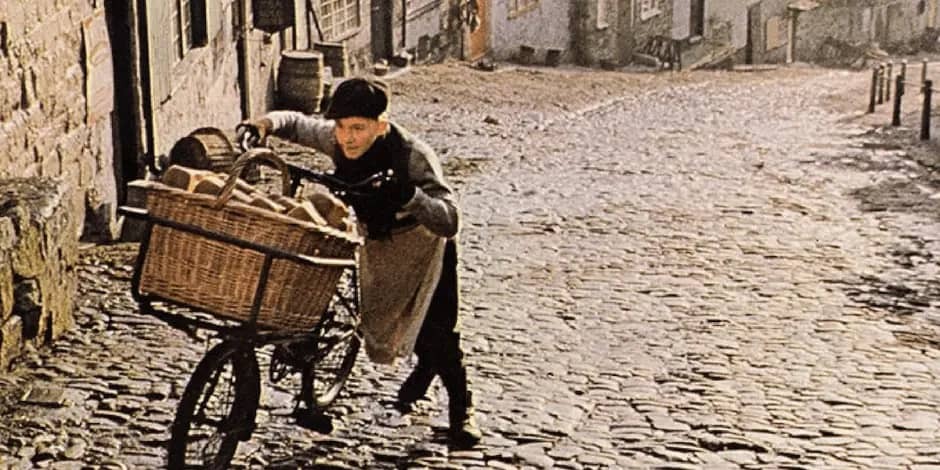
In 1944, Durk was only thirteen when he said goodbye to his parents and worked as an apprentice baker in the village, Echtenerbrug Netherlands..
At 4:30 AM, he stumbled out of his warm bed to gather the wood for the oven. There was no electricity, so all the mixing and kneading for 300 loaves was done by hand.
The baker would sometimes tell him, “Take an extra five loaves on your bicycle to that house. They will need it this week.”
“I knocked at the door to deliver the bread. Before anyone answered, I heard people running upstairs. But I didn’t ask questions.”
In the house there was only one elderly woman, but somehow she had coupons for five. No explanation, nothing was said as to the families she was hiding.
Shocked, and remembering myself delivering newspapers at that age, I said “Durk, you were only thirteen!”
He paused, his grey-blue eyes challenging me, “What would you have done, Grayson?”
I had no answer. I still don’t.
Before the world ruptured into the chaos of WW2, our friends, Durk and his wife Mieke Schaap began their childhood lives in the quiet villages of the rural Netherlands. They should have grown up in peace. Instead, it wasn’t at all normal; they took on dangerous tasks, felt hunger, fear, and grew into young teens with adult responsibilities.
The Hunger Winter
Following a German blockade, food supplies to the Netherlands dwindled, and people in the city began to starve. They walked long distances to farms to trade their silverware, linens, and heirlooms for food. As the winter wore on, tens of thousands of children were sent from cities to the countryside so that they, at least, would get something to eat.
“Bread and potatoes. That’s what we lived on.” Mieke said. “Sometimes cabbage. Once in a while a parsnip or carrot.”
“What about meat?” I asked.
“If there was a pig, it was secretly slaughtered. And it had to be hidden from the Nazis.” Mieke responded. “All the cats had long since disappeared into the pot.”
When the refugees arrived in Mieke's town of Twisk, they had walked 55 kilometres. Children and families so fatigued, freezing, so weak from hunger they just collapsed.
Things got even worse before the war ended. The bread they baked was hardly bread at all. Without yeast, and because the flour was infested with maggots, the baker used vinegar to kill some of the bugs before baking.
Durk remembered sadly, “The crusty whole wheat loaves now tasted like lumpy soggy pancakes.”
“We just did our best with the little we had,” Mieke concluded. “If someone needed help, you helped. That’s all.”
But it wasn’t “all.” Their story, a farm girl and a delivery boy, calls out courage.
When I listen, in the softness of their old age, I marvel at the strength that resides inside my friends. They speak without drama, without pride, almost apologetically.
The heroes of history often look completely ordinary.
We live in a world that celebrates influencers, who seek out many followers.
Durk and Mieke's private lives remind me that true character is mostly revealed in the costly choices nobody sees.
Caption of the picture:
Kilometres of cycling through the dark, in cold rain, and with an anxious fear of being caught. For sixty households; he carried up to 100 loaves in large wooden box strapped to the front of his bike.
Author: Grayson Bain